Mark Power Special Prize – Beyond the Surface: the selected projects
We are proud to announce the three projects selected for the Mark Power Special Prize – Beyond the Surface, personally chosen by Mark Power, president of the jury for the Projects & Portfolios section of the 17th edition of URBAN Photo Awards.
The Mark Power Special Prize – Beyond the Surface is a curatorial recognition for projects with strong visual coherence and a sustained enquiry into landscape as a layering of the real, alert to the often subtle tensions running through spaces and through the lives that inhabit them.
At Magazzino 26, in Porto Vecchio, the venue for the flagship exhibitions of Trieste Photo Days 2026, from 23 October to 8 November Power will present a selection from Good Morning, America, his long-term project on the United States. Here are the three projects that will be shown alongside his images:
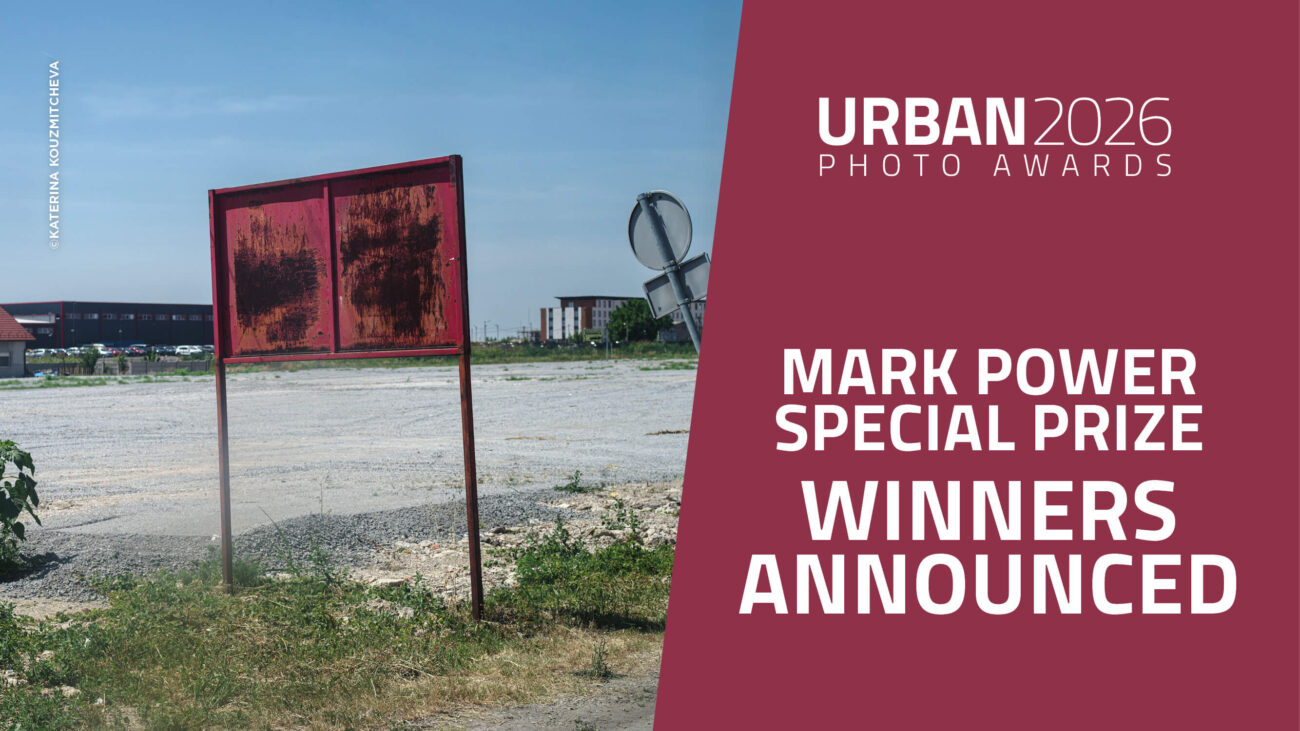
Katerina Kouzmitcheva – The Colour Beneath the Grey
Belgrade’s post-socialist architecture is habitually read through its surfaces: concrete, repetition, façades, infrastructure. Kouzmitcheva photographs what happens inside and around those structures, in courtyards, entrances, staircases and fragments of façades, where waiting, gathering, playing and small acts of care redefine a strict, repetitive geometry day after day. The colour of the title is the intensity of human presence within inherited structures: the concrete endures, and it is people who give it tone, scale and resonance.
Federico Possati – The Archaeological Bazaar
An enquiry into the Italian Pianura Padana, a territory that over the past century has moved from farmland to a hybrid of fields, factories, malls and tourist destinations that resists classification. Over two years of travelling, Possati has gathered images of objects, artefacts and abandoned places whose origin and function are slowly being erased. The project takes the form of a book made up of four booklets, each building a new context for those subjects, from indecipherable symbols to images worn away by time and memory. The title is borrowed from the writer Gianni Celati.
Michelle Sank – Burnthouse Lane
The Burnthouse Lane council estate was designed by Exeter Council in the 1920s along Garden City lines, to rehouse people from the West Quarter slum. Its isolation and its intricate labyrinth of lanes have produced a close-knit and supportive community, and it is this dimension that Sank brings to the foreground. The houses, largely identical in fabric, carry a personal stamp in their gardens, windows and wall faces; strong colour and light heighten the celebratory quality of a body of work that asserts beauty, dignity and presence against the usual representations of marginalised communities.
The three projects share with Power’s own practice an attention to places as repositories of history and everyday life, in a dialogue between visions of the world rooted in the real and open to more evocative dimensions.
Mark Power
One of the leading figures in contemporary British documentary photography, Power has built over more than forty years a rigorous, contemplative practice founded on long-term projects that explore the relationship between landscape, local culture and social change. His images, made with the slowness imposed by the large-format camera, do not stop at the surface: they investigate the space between description and imagination, between how places appear and how they are remembered and evoked.
After a degree in Fine Art (Painting) in 1981, he chose the camera during two years of backpacking across Asia and Australasia; returning to the UK at the end of 1983, he spent a decade working in publishing and the charity sector before being appointed Professor of Photography at the University of Brighton, a post he held for 25 years. He joined Magnum Photos in 2002 and became a full member in 2007. His work has been exhibited in galleries and museums worldwide and is held in significant public and private collections, though his medium of choice is increasingly the photobook: he has published 16 to date.